
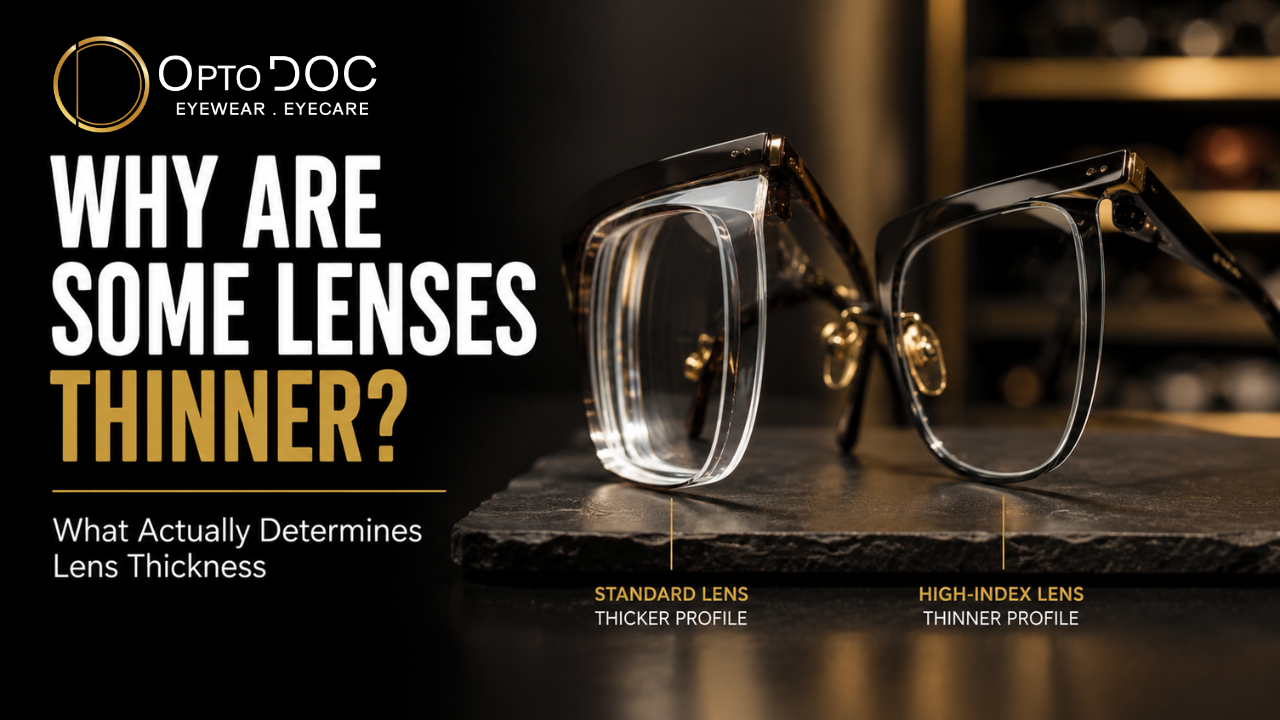
Why Are Some Eyeglass Lenses So Much Thinner Than Others?
Pick up two pairs of prescription glasses and you might notice something immediately.
One pair has incredibly thin, lightweight lenses. The other has lenses that are noticeably thicker around the edges or through the centre.
So what makes the difference?
It isn’t simply the style of the glasses. The thickness of your lenses can depend on your prescription, the material used to make them, the size and shape of your frames, and several other factors.
Your Prescription Plays a Major Role
The stronger your prescription, the more your lenses generally need to bend light to properly correct your vision.
That can affect the physical shape and thickness of the finished lens.
For example, lenses for stronger nearsighted prescriptions may be thicker toward the edges, while stronger farsighted prescriptions can be thicker toward the centre.
What Are High-Index Lenses?
One option that may be recommended for certain prescriptions is a high-index lens.
High-index materials are designed to bend light more efficiently than some conventional lens materials. This can allow certain prescriptions to be produced using thinner lenses.
For people with stronger prescriptions, that may provide both cosmetic and comfort advantages.
Your Frame Choice Matters More Than You Might Think
This is where choosing glasses becomes particularly interesting.
Two people with similar prescriptions can end up with very different-looking lenses depending on the frames they choose.
Frame size, shape, and how the frame sits relative to your eyes can all influence the finished result.
For certain prescriptions, a smaller frame may help reduce visible lens thickness compared with an oversized frame.
That’s Why Picking Frames Isn’t Only About Face Shape
We love helping patients find frames that look great—but appearance is only part of the equation.
A good eyewear consultation also considers:
- Your prescription
- Your preferred frame size
- How the frame fits your face
- Your everyday activities
- Lens material
- Comfort and weight
- Your personal style
The goal is to find a combination of frames and lenses that works together.
Are Thinner Lenses Always Better?
Not necessarily.
The best lens depends on your individual prescription and needs. Someone with a mild prescription may not benefit from the same lens material as someone with a much stronger prescription.
That’s why choosing lenses based only on the word “thinner” isn’t always the best approach.
Your eye care and optical team can help explain the options available for your prescription.
What About Lens Weight?
Lens thickness and lens weight can affect how glasses feel after several hours of wear.
For someone who wears glasses from morning until bedtime, comfort matters.
The right combination of lens material, frame design, and proper adjustment can make eyewear much more enjoyable to wear throughout the day.
Don’t Forget About Lens Coatings
The material isn’t the only decision involved when ordering lenses.
Depending on your needs, you may also discuss options such as anti-reflective coatings, scratch-resistant treatments, UV protection, or other lens features.
These options don’t simply change how your glasses look—they can influence how your eyewear performs in everyday situations.
Let OptoDoc Help Build the Right Pair for You
At OptoDoc, choosing glasses isn’t simply about pointing at a frame on the wall and hoping for the best.
Our team can help you understand how your prescription, lenses, and frames work together so you can make an informed decision about your eyewear.
And with a wide selection of frames available at our Fort McMurray clinic, you can explore different styles while our team helps you determine what works for your vision and your lifestyle.
Because the perfect pair isn’t just about the frame.
It’s about everything behind the lenses, too.
Why Do Your Eyes Need Time to Adjust to the Dark?
Ever wonder why you can barely see when you first enter a dark room? Learn how your eyes adapt to ch
How Fort McMurray’s Ever-Changing Weather Affects Your Eyes
Explore how Fort McMurray's weather affects your eye health and discover essential tips to safeguard
Can Your Eyes Get Sunburned? Understanding UV Eye Damage
Can your eyes actually get sunburned? Learn how UV exposure affects your eyes, why sunglasses matter