

Why Do Your Eyes Need Time to Adjust to the Dark?
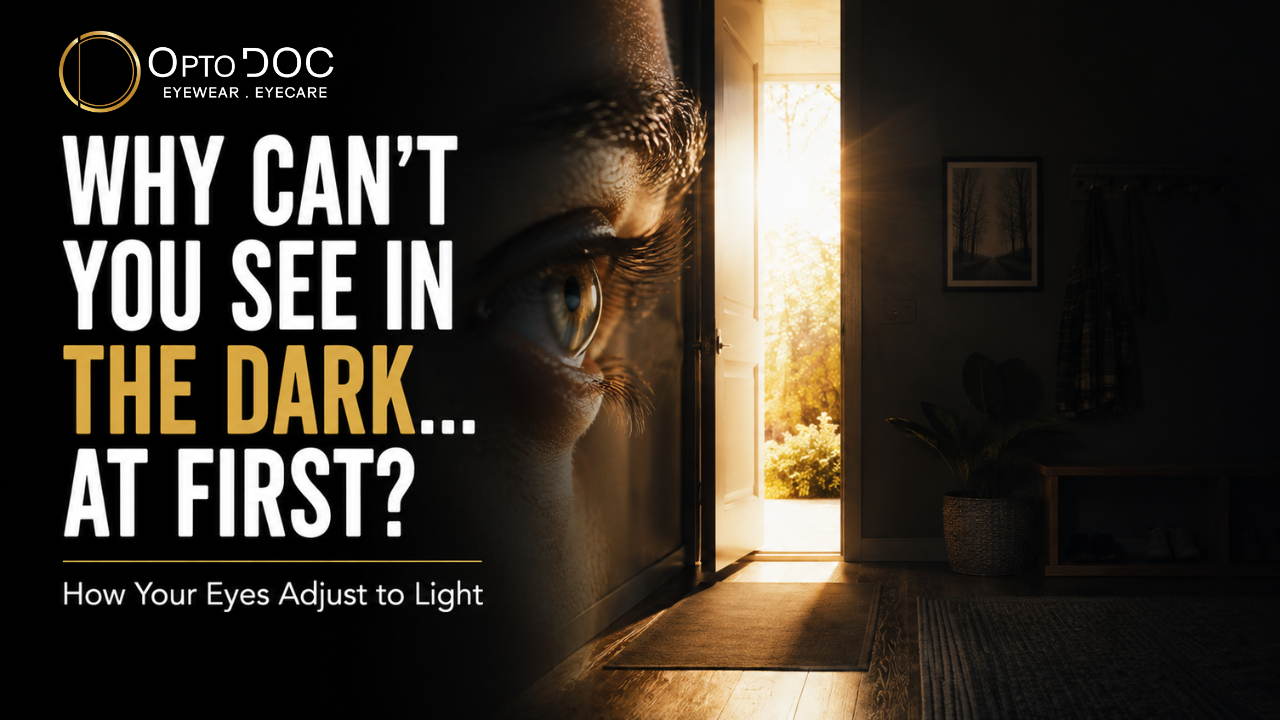
You walk indoors after spending time in bright sunlight and, for a moment, everything seems almost completely dark.
Then something interesting happens.
Slowly, shapes begin to appear. You can see furniture, doorways, and objects that seemed invisible only moments earlier.
The room didn’t get brighter.
Your eyes adapted.
Your Eyes Have Two Very Different Lighting Jobs
Your visual system needs to handle everything from a bright summer afternoon to a dim bedroom at night.
Specialized cells in the retina help make that possible.
Cones are especially useful for detailed and colour vision under brighter conditions.
Rods are highly sensitive to lower levels of light and become particularly important when you’re trying to see in darkness.
When lighting conditions change dramatically, your visual system has to adjust how it processes the environment around you.
What Happens When You Enter a Dark Room?
Imagine you’ve been outside on a bright afternoon in Fort McMurray.
You walk into a dark room and initially struggle to see anything.
Your pupils begin responding to the lower light level, allowing more light to enter your eyes. At the same time, the retina gradually becomes more sensitive to the limited light available.
That entire process is known as dark adaptation.
Why Doesn’t It Happen Immediately?
Your pupils can react relatively quickly, but pupil size is only one part of the process.
The light-sensitive systems within the retina also need time to adapt.
That’s why you may notice some improvement within the first few moments while your ability to see finer details in very low light continues improving afterward.
Why Does Bright Light Ruin Your Night Vision?
Here’s something you may have experienced while looking at your phone in a dark room.
Your eyes have adjusted to the darkness. You check a bright screen for a moment, look away—and suddenly the room seems much darker again.
The bright light temporarily changes how adapted your visual system is to the dark environment.
Your eyes then need time to readjust.
Why Can Low-Light Vision Feel Different as We Age?
Vision naturally changes throughout life, and some people notice that adapting to darkness doesn’t feel quite as quick or comfortable as it once did.
Changes within the eye can influence how efficiently light reaches and is processed by the retina.
This can become particularly noticeable when moving between bright and dark environments or when trying to see in dimly lit spaces.
What About Driving at Dusk?
Dusk can be visually challenging because your surroundings are constantly becoming darker while headlights, traffic signals, and illuminated signs remain bright.
Your eyes are effectively dealing with multiple levels of brightness at the same time.
Having an up-to-date prescription and properly maintained eyewear can help ensure your vision is performing as well as possible under changing conditions.
When Is Difficulty Seeing in the Dark Worth Mentioning?
Some adjustment between bright and dark environments is completely normal.
However, if you notice a significant change in your ability to see in low light, unusually long adjustment times, or difficulty navigating environments you previously handled comfortably, mention it during your eye exam.
A comprehensive eye exam can help your optometrist evaluate both your vision and the health of your eyes.
Your Eyes Do More Than You Realize
Most of us never think about light adaptation because our eyes handle it automatically.
But every time you walk from bright sunlight into a movie theatre, turn off the bedroom lights, or step outside at night, an incredibly sophisticated visual system is adjusting behind the scenes.
Keep an Eye on Your Changing Vision with OptoDoc
At OptoDoc in Fort McMurray, comprehensive eye exams aren’t only about determining whether you need glasses.
They’re also an opportunity to evaluate your overall eye health and discuss changes you’ve noticed in everyday situations—including how well you see under different lighting conditions.
If something about your vision doesn’t feel the way it used to, don’t simply assume it’s something you have to accept.
Bring it up at your next eye exam. Sometimes the little things you notice can provide valuable information about your vision.
Does Insurance Cover All Frames?
Learn what eyewear insurance typically covers, how it applies to frames, and how OptoDoc helps you m
The Importance of Eye Health: A Comprehensive Guide
At OptoDoc, we are dedicated to providing top-notch eye care services to ensure your eyes stay healt

How Do UV Rays Affect Your Eyes?
Learn how UVA/UVB light impacts your eyes year-round, the conditions it can cause, and how to protec